
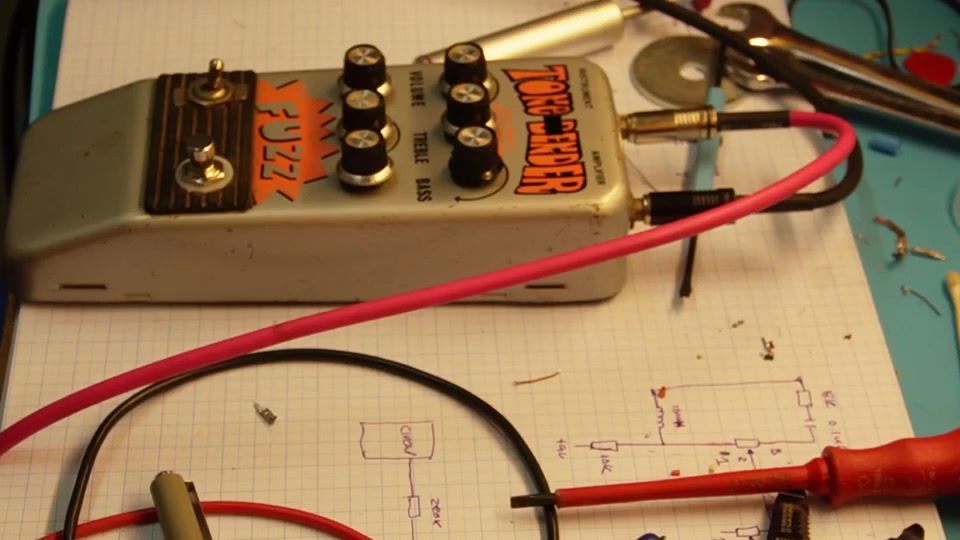
The reported fault
Why replacing the switch wasn’t enough.
The pedal arrived with an audible pop whenever the effect footswitch was operated. Moving the original output wiring also produced noise and heavy buzz. Those symptoms needed investigating separately, rather than assuming the switch accounted for everything.
I fitted a good-quality replacement footswitch, but the pop remained. Trying 430 kΩ pulldown resistors at the input and output did not fully cure it either. The next step was to look more closely at the wiring, earth connections and output circuit.
This is a 1974 Tone Bender-type germanium fuzz; its exact circuit variant has not been confirmed. The findings here describe this particular pedal, not every Tone Bender.
Separating the symptoms
Dealing with the handling-sensitive wiring.
I replaced the input and output signal runs with screened cable, grounding the screens at the jack end, and remade solder joints and earth connections at the jack sockets.
With the fuzz circuit disconnected, the switching and handling noise was eliminated after that work. Reconnecting the circuit brought back an electrical pop. That distinction mattered: the wiring repairs had addressed a real problem, but they had not, on their own, resolved the complete fault.
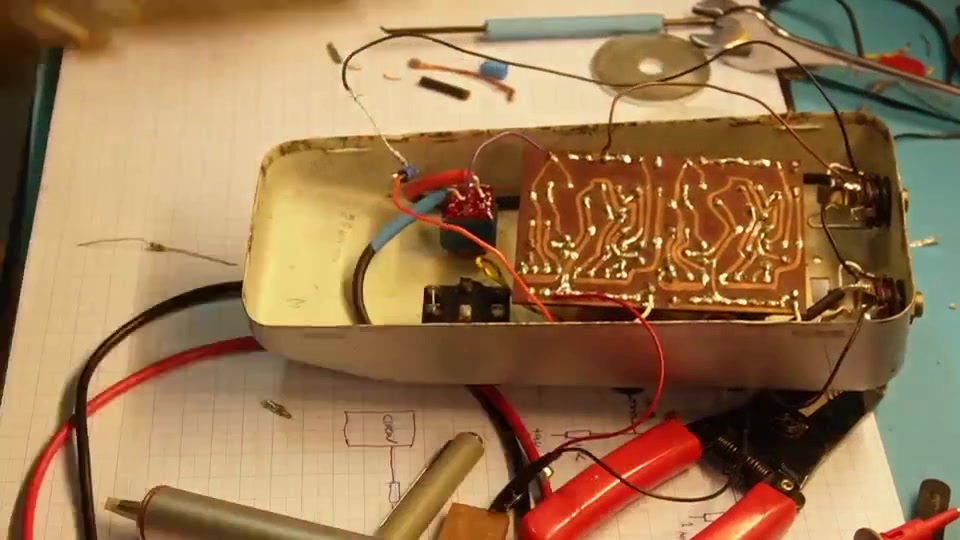
Following the output circuit
DC was reaching the switch.
Inspection found a DC path from the tone network, through a 220 kΩ resistor, to the output control and switch, with no coupling capacitor at that point.
An initial reading at the output control wiper and effect-side switch connection was approximately 8.54 V DC relative to the jack sleeve. That gave me a specific part of the circuit to address, alongside the wiring work already carried out.
I installed a 1 µF series coupling capacitor between the output control wiper and the effect-side switch connection, with a 430 kΩ pulldown resistor from the switch side of the capacitor to circuit ground. This provided DC isolation at that connection and a defined path to ground on the switch side.
With that arrangement fitted, the steady DC reading at the effect-side switch terminal was approximately 1–2 mV with the effect engaged.
Checking the result
Final assembly and a play test.
The replacement switch, screened signal wiring, renewed solder and earth connections, and output coupling network were retained together. I tidied the wiring, completed the assembly and tested the pedal in use.
The switching pop was cured. The footswitch was quiet during normal guitar playing, and the controls and fuzz effect operated correctly.
The evidence supports both a wiring-related noise contribution and a circuit-related switching transient. Because the precise contribution of each repair was not isolated, I would not attribute the whole result to the capacitor—or to the new switch—alone.